I’d like to start by telling you a story from the country where I live, Germany. It is the story of Max Planck, the great German physicist. In 1918 Professor Planck won the Nobel Prize for his work on quantum theory. With this new fame he was asked at universities throughout Germany to give speeches on his discoveries. One evening he was due to give a speech in Munich. On the way there, Planck was having a discussion with his driver and his driver asked him if he had prepared the speech he was to give that night. Planck answered ‘no, I haven’t prepared, I have given this speech so many times that I can tell it by memory.’ His driver responded, ‘I have heard your speech so many times I could probably give it.’ Hearing this, Max Planck thought for a moment and then said to his driver, ‘why don’t we test your theory and you dress nicely and give the speech and I’ll sit in the front of the audience and pretend to be your driver and we’ll see if anyone notices.’
Friday, 30 December 2011
Speech delivered by Aaron Kahland at Orania Burgervergadering ( = Citizens meeting)
I’d like to start by telling you a story from the country where I live, Germany. It is the story of Max Planck, the great German physicist. In 1918 Professor Planck won the Nobel Prize for his work on quantum theory. With this new fame he was asked at universities throughout Germany to give speeches on his discoveries. One evening he was due to give a speech in Munich. On the way there, Planck was having a discussion with his driver and his driver asked him if he had prepared the speech he was to give that night. Planck answered ‘no, I haven’t prepared, I have given this speech so many times that I can tell it by memory.’ His driver responded, ‘I have heard your speech so many times I could probably give it.’ Hearing this, Max Planck thought for a moment and then said to his driver, ‘why don’t we test your theory and you dress nicely and give the speech and I’ll sit in the front of the audience and pretend to be your driver and we’ll see if anyone notices.’
Wednesday, 17 February 2010
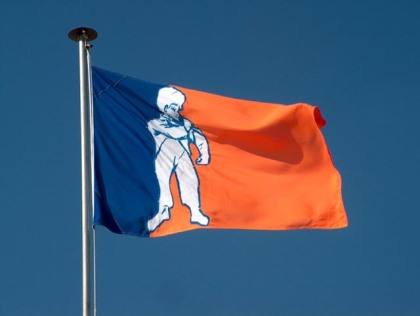
Orania
A regular reader at this blog has written to me asking if I would add a link to the Website for the Village of Orania in South Africa's Northern Cape. I was delighted to do so, and the link can be found about a third of the way down the right hand side bar. Most of the text is in Afrikaans but non Afrikaans readers can make some sense of it by using Google's Dutch to English translationm facility.Wikipedia describes Orania as a separatist, self-governing, Afrikaner Volkstaat. However, the blog reader describes it as follows:
The town was started by SA dept. of water affairs in the 1960’s to house workers to build the Vanderkloof -dam but after the dam was finished the town ran empty and stood empty and destroyed for nearly 20 years until 1991. When some right-wingers knowing that apartheid would not hold bought it. Until that time because of the abundance of cheap black labour, most manual work was done by blacks, dependence and segregation can not exist simultaneously (and it was the reason apartheid was unworkable). In 1992 the first Afrikaners moved into Orania, everyone thought they were nuts, racist extremist/radicals/Nazis, liberal journalists had a field day of insulting them.
It went very slow at first at first, the town has a policy of Volkseiearbeid (own labour) all work is to be done by whites, The town grew steadily to a population of around 350 and the uncertainty around 1994 did help of course. The first 10 years was harsh, new people came and many left again with population remaining around 400, I must quantify this by stating that the town is in semi-desert area with summer temperature reaching 40 C and winter -7C (unforgiving) and creating infrastructure and a economy from nothing and without any government help (while having to pay taxes) is near impossible. To most Boer-Afrikaners own labour also represented a bit of a cultural revolution, they understood that the use of foreign labour is what cost them there land and independence but change is never easy.
Since about 2001 the town started picking up slowly but surly, more and more outside supporters started joining there movement, better informed settlers and more capital investments started poring in and today it is a thriving little white community making the desert bloom with a population of about 750 and growing. How big they eventually will grow and how far they will be able to take there independence, only time will tell but with so many whites fleeing Africa this might one day become the only place in Sub-Sahara Africa where whites are found.
Here is also a link to some videos of Orania:
http://www.youtube.com/user/
